

Scalable Airport BHS Engineering for Vision-Scale Infrastructure Projects
A BHS’s performance is not decided on the day of commissioning. It is decided months, sometimes years, in advance, during the design phase.
When a system runs without interruption, no one notices the work behind it. When bottlenecks, delays, or lost baggage occur, the cause is rarely a single piece of equipment. In most cases, problems originate in architecture, integration, or sizing decisions made long before the first conveyor was installed.
This is one of the reasons why airport projects in the Persian Gulf region are so relevant from an engineering perspective. Not solely because of their scale, but because they push every design decision to its limits. High baggage volumes, fixed inauguration deadlines and strict availability requirements leave no room for compromise. An airport has no break-in period after opening; the system must work correctly from the first flight.
The engineering principles validated under these conditions are not relevant only to international hubs. They are the same principles that make a regional airport more reliable, easier to expand and simpler to operate. This article examines these principles through the lens of IESYS’s experience in airport projects.
1. CONTEXT: WHY GULF PROJECTS ARE TECHNICALLY RELEVANT
The GCC (Gulf Cooperation Council), comprising Saudi Arabia, the United Arab Emirates, Qatar, Kuwait, Bahrain and Oman, has produced some of the world’s most prominent international airports over the past two decades. Dubai, Doha and Abu Dhabi have redefined the concept of an intercontinental hub in practice.
What is currently being built represents a new chapter in this program, driven largely by KSA (Kingdom of Saudi Arabia) and characterized by factors rarely encountered simultaneously: large scale, speed of execution, greenfield development,and strict delivery deadlines.
Saudi Arabia is investing over $100 billion in transforming its aviation sector, targeting 330 million passengers annually by 2030 across 250 destinations (Source: National Aviation Strategy, GACA, General Authority of Civil Aviation). KSIA (King Salman International Airport, Riyadh) is the flagship project: a $30 billion program designed for 120 million passengers per year by 2030 and 185 million by 2050, with construction commenced in September 2025 (Source: Airport Technology, KSIA project profile, December 2025).
"The Middle East aviation market is estimated to reach $33.70 billion by 2029. Saudi Arabia holds 42.5% of the regional airport construction pipeline, the largest share in the region."
Global Airports Forum, October 2025
For a BHS (Baggage Handling System) integrator, the new Gulf terminals present a different set of parameters from anything encountered in European modernization projects: high processing volumes per EDS line, availability requirements comparable to those in critical industries and a commissioning schedule that cannot be negotiated.
Saudi Arabia’s other major airports are undergoing full transformation. King Abdulaziz International Airport in Jeddah is receiving a $31 billion investment to reach 114 million passengers annually. King Fahd International Airport in Dammam is targeting 19.3 million passengers per year by 2030, with a projected cargo capacity exceeding 600,000 tonnes per year (Source: Construction Week, July 2025; Saudi Gulf Projects, July 2025).
In 2024, the region’s main airports were operating at 96–98% of their designed capacity (Source: Arab News, November 2025). Saudi Arabia recorded a 36% increase in travel volumes in the summer of 2025, the highest level in its history (Source: Travel and Tour World, November 2025). Qatar and Bahrain also recorded passenger numbers, indicating structural expansion, not a seasonal fluctuation.
The investment program extends beyond the 2030 horizon. Projects under construction or in advanced planning stretch toward 2035 and target an airport network capable of supporting over 300 million passengers per year across the GCC region — a figure that places Gulf aviation infrastructure in the same capacity bracket as the world’s largest airport systems. For BHS integrators, this means the qualification window for infrastructure projects at this scale is open now, not in 2030.
“The Middle East aviation market is estimated to reach $33.70 billion by 2029. Saudi Arabia holds 42.5% of the regional airport construction pipeline, the largest share in the region.” — Global Airports Forum, October 2025
For a BHS (Baggage Handling System) integrator, the new Gulf terminals present a different set of parameters from anything encountered in European modernization projects: high processing volumes per EDS line, availability requirements comparable to those in critical industries and a commissioning schedule that cannot be negotiated.

2. BHS CAPACITY IS NOT DETERMINED BY SCANNERS, BUT BY HOW THE ENTIRE SYSTEM IS DESIGNED
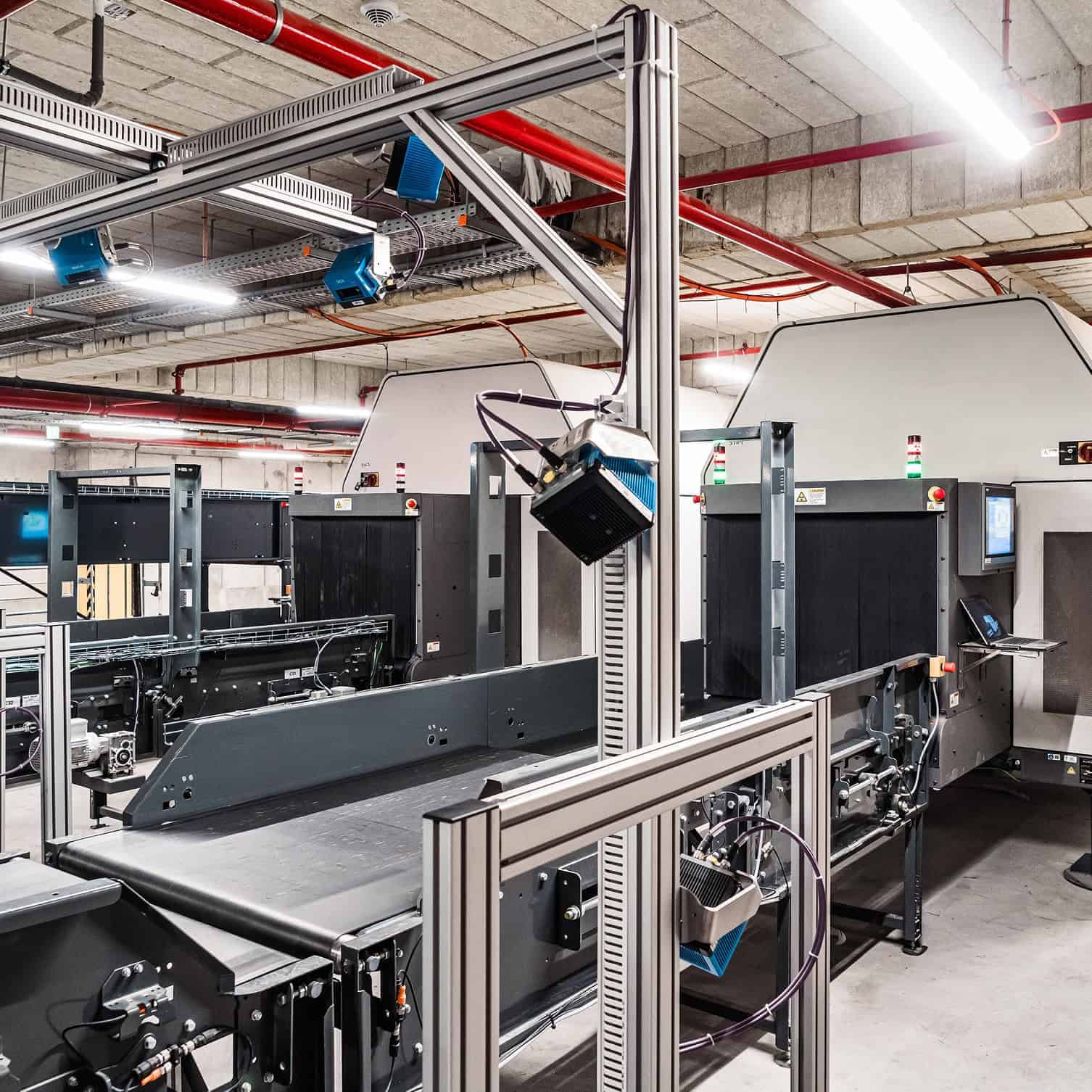
One of the most widespread misconceptions is that BHS performance depends primarily on the EDS (Explosive Detection System) scanner. In reality, this is a single component within a far more complex system.
The actual capacity of a line is not determined by the performance of a single piece of equipment. It depends on the flow architecture, the positioning of divert points, the sizing of accumulation zones, the routing logic and the way the system manages peak traffic periods. An undersized accumulation zone or an improperly designed flow intersection point can constrain the entire system, regardless of the performance of the equipment installed downstream.
This is why BHS design always begins with understanding how the airport will operate and how baggage will move — and only then with equipment selection.
System design precedes equipment decisions
A BHS is sized starting from the terminal’s operational requirements. Buffer capacity, route architecture, the number of EDS lines and conveyor network configuration all follow from these requirements. A typical input parameter is the volume within the 15-minute interval of the peak traffic hour. When correctly translated into the system architecture, this figure determines the installation’s behavior under the most demanding conditions.
A BHS must be designed for continuous operation and for interventions that may occur at any point in the operational cycle. An international hub and a regional terminal differ in volume and complexity, but both require a system designed for long-term availability and maintainability.
Every curve and every transfer point matters
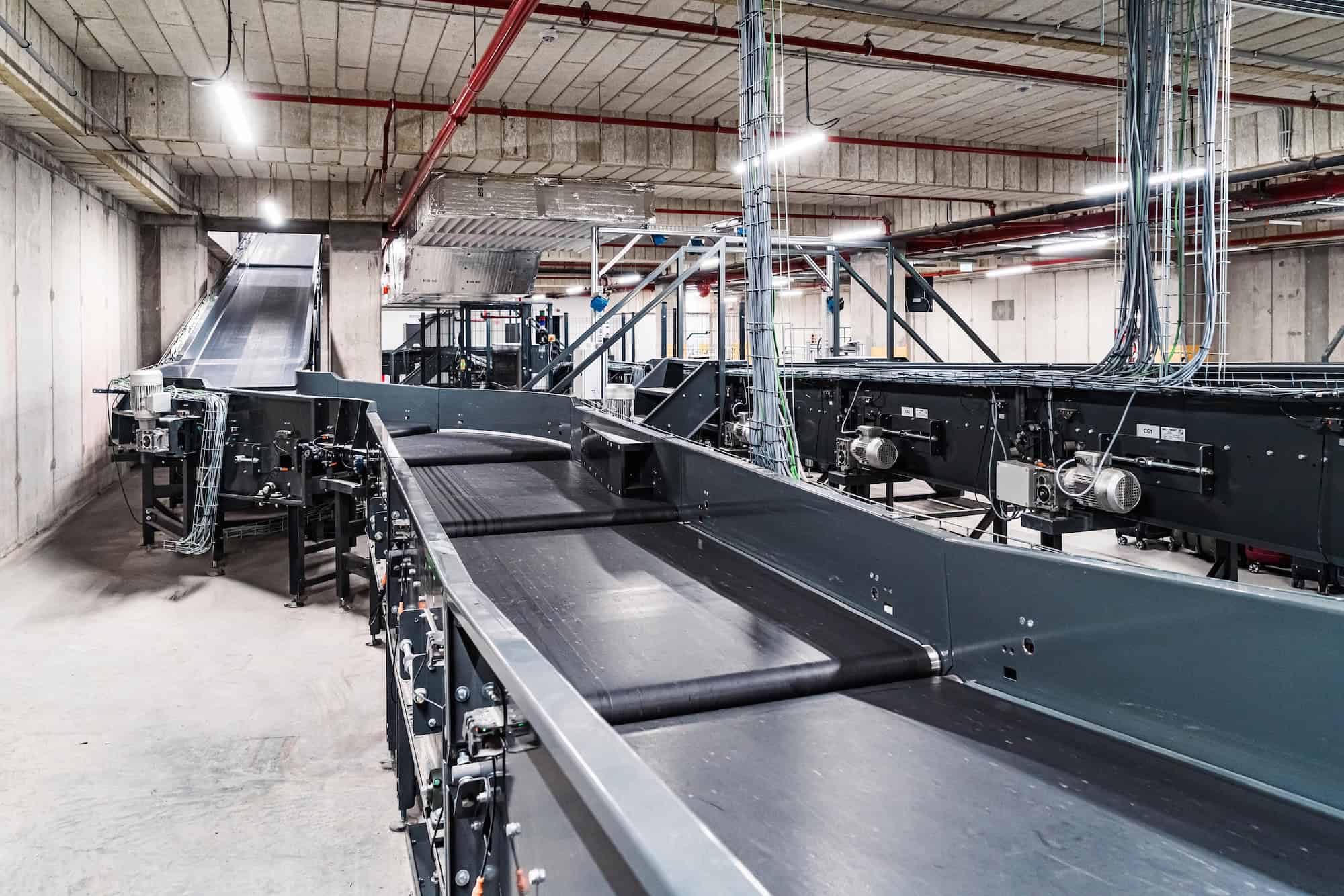
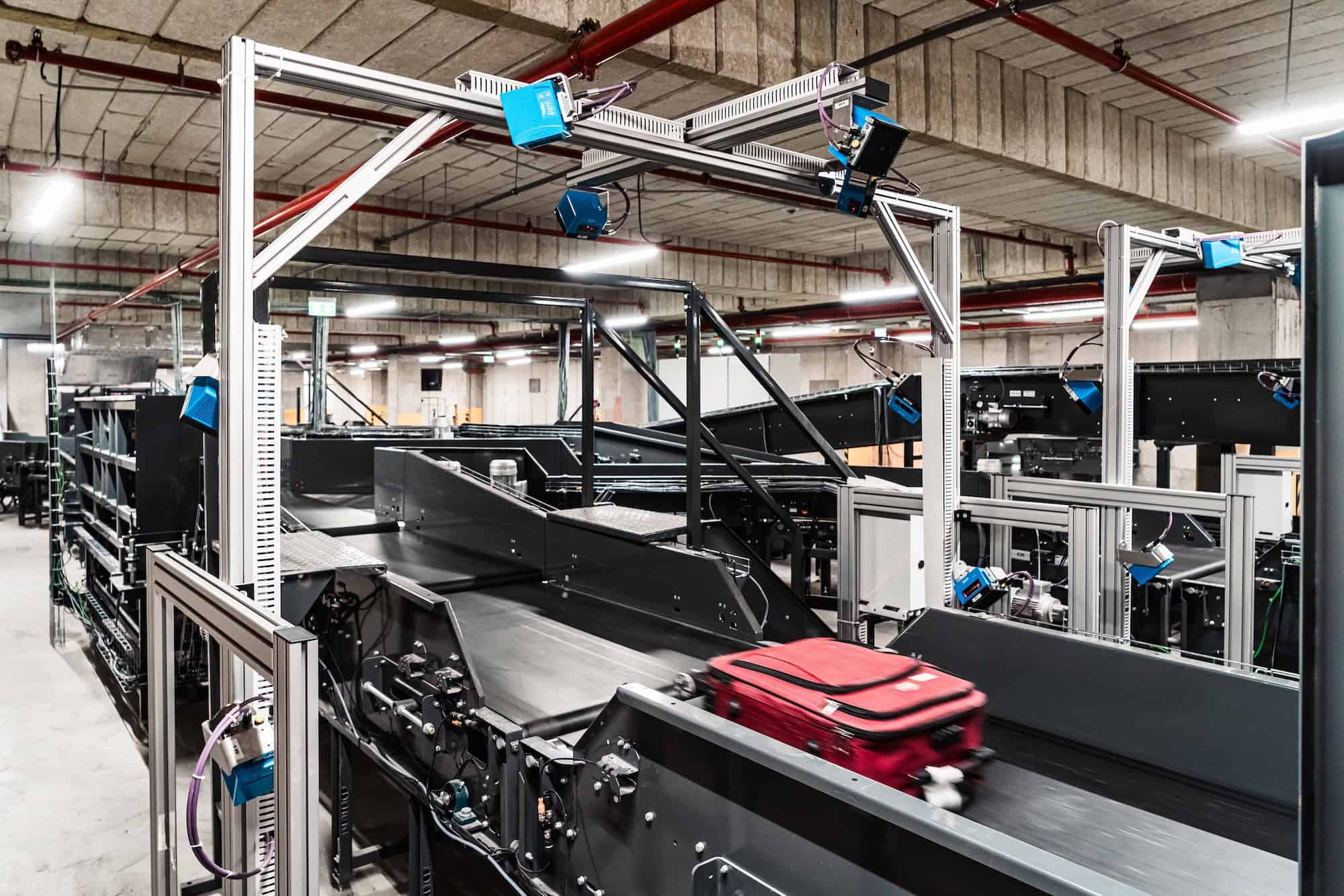
In a BHS, every curve, every speed and every transfer point has direct consequences on flow. A bag that loses stability for a few seconds can become the start of a jam that propagates throughout the system. Gradual transitions, zone-calculated speeds and the elimination of abrupt direction changes are design decisions that translate directly into processing capacity. Automatic bag centering systems, installed before each EDS unit, ensure that every bag enters the scanner in the correct position.
Infeed capacity and the time window
Infeed and outfeed capacity must be sized against peak traffic periods, not just average volume. A system sized for stable conditions can quickly reach its limits when multiple departure flows overlap and baggage volumes spike within a short interval.
The critical parameter is the total window available between check-in drop-off and loading onto the make-up carousel. If we consider the hypothetical scenario in which check-in closes 40 minutes before departure, the bag must travel the entire line in under 15 minutes, to allow for handling, loading into ULDs (Unit Load Devices) and delivery to the aircraft before departure.
Testing: FAT and SAT
System behavior must be verified before entering service. Staged simulation and testing allow logic, integration and coordination issues to be identified before they arise under real terminal conditions.
- FAT (Factory Acceptance Testing): verifies component functionality in a controlled environment before delivery to site. For a high-throughput BHS, full physical testing in the factory is not practicable; software simulation covers this gap at the system level.
- SAT (Site Acceptance Testing): confirms that the integrated system functions under real conditions, with simulated baggage flows. This is the essential stage regardless of project scale.
Continuous monitoring and response to disruptions
Once the system is operational, the SCADA (Supervisory Control and Data Acquisition) platform provides full visibility of the status of every segment, the position of every bag and all operating parameters. Deviations are detected automatically and trigger rerouting before disruptions become visible at the operational level.
Planning for partial operating conditions is an integral part of the design. Every BHS is configured for controlled degraded-mode operation — reducing capacity in an orderly manner, without total shutdown, with automatic flow rerouting and activation of alternative paths.
Maintenance and energy efficiency
Terminals in the Persian Gulf region operate continuously, with a high number of daily operating hours and local technical teams that are often still in training. Monitoring of operating parameters can support predictive maintenance strategies.
A high-throughput terminal is a significant energy consumer. High-efficiency equipment and modular zoning — which allows inactive zones to operate in reduced mode outside peak traffic hours — contribute to consumption reduction, in line with the ESG (Environmental, Social and Governance) commitments made by airport operators.
3. INTEGRATING STANDARD 3 SCREENING TECHNOLOGY
HBS (Hold Baggage Screening) refers to the process by which all checked baggage is subjected to security screening before loading. ECAC Standard 3 (European Civil Aviation Conference) represents the current benchmark for hold baggage screening in Europe and is increasingly required at international airports across the GCC.
CT technology is changing the way screening is integrated into the BHS flow. The equipment generates three-dimensional images and has different integration requirements compared to conventional screening systems, which is reflected in the space required, mechanical and electrical interfaces, alarm flows and control architecture.
From a BHS integration standpoint, Standard 3 equipment raises three distinct categories of engineering challenges:
- Physical footprint: CT equipment is larger and heavier, requiring recalculation of the line configuration, floor loading and the spacing of mechanical infrastructure in the baggage hall.
- Capacity matching: the performance of a screening unit is only achieved in practice when the entire line — infeed and outfeed conveyors — is sized accordingly.
- Alarm flow management: bags held at Level 1 screening are directed to the OSR (Operator Screening Room). If the alarm is confirmed, the bag is directed to the CBRA (Checked Baggage Resolution Area) for manual inspection. Both areas must be sized to absorb the volumes generated by the EDS lines; insufficient sizing turns them into bottleneck sources on the primary line.
IESYS approaches Standard 3 integration at the complete system level: infeed accumulation zones sized for peak traffic, divert paths with sufficient buffer toward the CBRA and control software configured for dynamic load distribution across multiple EDS units
4. MODULAR ARCHITECTURE: EACH TERMINAL ZONE OPERATES INDEPENDENTLY
Large-scale airport projects have a specific characteristic: construction and operation can overlap. Some sections of the terminal may enter service before others are complete. In this context, a modular architecture allows the system to be developed and modified without each local intervention requiring a full BHS redesign.
A modular system means that each terminal zone is designed to operate independently, so that a local intervention does not affect the operation of the entire airport. If a segment is under maintenance, the baggage flow is handled by adjacent segments.
When a new pier enters service, new check-in lines, screening zones, or make-up positions can be integrated without major changes to the existing system. Extension elements are planned from the design stage: pre-positioned conduits and supports, spare ports on the control network and software licensing structured to accommodate capacity additions.
This principle is also applied by IESYS in regional projects at Oradea International Airport and Iași International Airport. At Oradea, the BHS features a modular layout with EDS integration and centralized SCADA monitoring, with explicit provisions for future expansion. At Iași, configurable routing and increased processing capacity address anticipated traffic growth without requiring replacement of the core infrastructure.
5. HIGH AVAILABILITY, REDUNDANCY AND OPERATIONAL CONTINUITY
BHS availability is directly linked to the terminal’s operational continuity. In a high-volume hub, a significant system outage can affect baggage processing, departure flows and, under certain conditions, the airport’s operational schedule, with direct economic consequences.
The control architecture draws on principles from critical industrial environments — energy, petrochemicals — adapted to the specific requirements of airport operations:
- Ring topology for the control network: industrial networks are designed with ring topology; if one segment is interrupted, communication is automatically restored via the alternative path, within milliseconds.
- Active redundancy (Hot Redundancy) at PLC (Programmable Logic Controller) level: a primary and a secondary controller run simultaneously, continuously synchronized. Switchover to the secondary occurs instantaneously, with no data loss.
- SCADA platform redundancy: implemented with a primary and secondary server with real-time database replication.
- N+1 philosophy at the mechanical level: every critical mechanical path or piece of equipment has one standby unit (N active + 1 standby). Moving to N+2 or N+3 adds components that require maintenance and additional floor space, which can significantly reduce overall resilience. The engineering objective is the right redundancy in the right locations.
6. PROJECT DELIVERY: FROM RFQ TO COMMISSIONING
The inauguration is a fixed point in the calendar and most delays arise when essential decisions are deferred: selecting long-lead equipment, coordinating with civil works, or securing electrical supply.
The RFQ (Request for Quotation) marks the formal start, but IESYS’s involvement begins in the pre-design phase. The initial analysis identifies critical schedule items, civil coordination requirements and commissioning prerequisites, planned in detail together with the General Contractor (GC).
In airport projects with tightly controlled commissioning deadlines, coordination must cover interface boundaries, site access windows and utility and infrastructure availability sequences.
Commissioning also confirms software integration with airport systems: AODB (Airport Operational Database), DCS (Departure Control System), BRS (Baggage Reconciliation System) and FIDS (Flight Information Display System).
7. LIFECYCLE ENGINEERING: A SYSTEM THAT REMAINS RELEVANT BEYOND 15 YEARS
A commissioned BHS will operate for 15–20 years, during which time adjacent systems will be replaced or updated. A BHS built on a closed architecture quickly becomes an operational constraint — a situation documented at several European airports with infrastructure installed in previous decades.
IESYS builds software platforms on open architectures, with standardized interfaces that allow integration with new technologies without replacing the BHS core. Pre-design decisions — component selection, network topology, modular extension provisions — determine the cost of long-term maintenance and upgrades.
IESYS provides technical support across the full lifecycle: custom design, in-house software development, FAT and SAT, technical training and ongoing maintenance, including structured knowledge transfer programs for local technical teams.
CONCLUSION
Technologies evolve, but the engineering principles of a reliable BHS remain constant: performance is decided before the first conveyor is installed. A well-designed system runs without interruption because problems were identified and resolved at the stage when the cost of correction was minimal. A system that fails after inauguration has, in most cases, not failed because of the equipment — it failed because of decisions made or omitted months earlier.
IESYS designs and integrates BHS systems for airports across Eastern Europe, the Balkans and the GCC/KSA region, with expertise in mechanical design, control architecture and in-house SCADA development.
Sources and references
- IESYS Group, Airport Solutions.
- IESYS Group, Baggage Handling Systems (BHS).
- IESYS Group, Integration with Airport Services.
- IESYS Group, Customized SCADA & Control Systems.
- Andrei Iacobita(General Manager of IESYS), Inside Today’s High-Stakes Baggage Handling Systems, Saudi Projects / TPG Media, 2026.
- GACA, Saudi Arabia’s Aviation Strategy.
- Airport Technology, King Salman International Airport (KSIA).
- Construction Week, Saudi Arabia Launches Major $427m Airport Upgrade Plan, July 2025.
- Saudi Gulf Projects, Saudi Arabia Announces New Master Plan for Three International Airports, July 2025.
- Arab News, Saudi Arabia’s sky in the near future, November 2025.
- Travel and Tour World, Saudi Arabia, Qatar and Bahrain lead GCC travel expansion, November 2025.
- Zawya / Global Airports Forum, Saudi Arabia works to triple its aviation capacity, October 2025.
- Smiths Detection, Upgrading to ECAC EDS Standard 3.
- Smiths Detection, HI-SCAN 10080 XCT.
- International Airport Review, Advanced HBS operational efficiency, December 2025.
- SITA, Baggage IT Insights, 2025.