

The Critical 5: BHS Constraints That Become Structural Limitations
5 Design Decisions That Can No Longer Be Delayed
- Episode 8 -
A monthly insight series by IESYS
A routing decision made in month 3 of a terminal’s design can become a structural problem discovered in month 30. This happens not because of an oversight, but because the real footprint of a BHS (Baggage Handling System), including access, maintenance and future capacity, rarely appears in early-phase drawings.
The BHS is one of the few terminal systems whose design reaches far beyond its own technical equipment and spaces. Routing, screening requirements, access and future capacity can influence how the terminal is structured, serviced, operated, and ultimately adapted over time.
When terminal design decisions are made without considering the BHS lifecycle, constraints migrate from one discipline to another: a routing decision can become a structural or MEP (Mechanical, Electrical, and Plumbing) issue; a screening requirement can reconfigure the baggage layout and a maintenance or expansion requirement can become a terminal constraint years after completion.
The challenge is not merely identifying these constraints, but understanding their impact before design decisions limit project options. This is why BHS engineering must be integrated into terminal design from the earliest phases.
Five areas require clarification while terminal design remains flexible:
1. The True BHS Footprint Extends Beyond the Equipment’s Physical Size
When developing a BHS layout, the available footprint is usually one of the first constraints considered. In practice, however, the footprint of conveyor belts and equipment represents only a portion of the space the system requires.
Access and intervention zones are essential for installation and maintenance. Drive units, sensors and other components must remain accessible for inspection and routine service. Equipment with a finite lifespan needs a practical removal strategy. Transfer points, diverters and screening equipment demand their own operational clearances, and level changes can introduce additional requirements that are difficult to discern from a plan view.
This distinction becomes particularly relevant in space-constrained terminals and retrofit projects, where clear heights, structural grids and existing infrastructure can significantly limit the BHS engineer’s available options. A layout can be geometrically feasible and still create real difficulties once installation, operation, maintenance or future modifications are taken into account.
The complete BHS footprint must be evaluated from installation, through operation and maintenance, up to future modifications, rather than treating physical placement within the terminal as the primary spatial constraint.
2. BHS Routing Has Consequences Beyond the Baggage System
BHS routing is typically developed around baggage flows, required capacity, equipment characteristics, and the available building geometry. Once the route enters the terminal, however, it becomes part of a much broader engineering coordination exercise.
A change in the route or placement of conveyor belts (including level changes) may require structural modifications, affect ceiling configurations, reduce space around equipment or conflict with MEP installations. Added to this are fire safety requirements, access routes and technical spaces, which can introduce further constraints. A routing decision based solely on baggage flow can shift the problem into the building’s structure, systems or technical areas.
Once the structural grid, levels and main services are fixed, options for resolving a routing constraint narrow significantly. The goal of coordination is not just to identify interdisciplinary conflicts, but to understand the consequences of BHS geometry before those consequences become fixed building conditions.
Identified early, routing constraints do not necessarily lead to compromise. They can lead to a different spatial configuration or architectural solution that would no longer be feasible once major building decisions are locked in.
3. Screening Requirements Can Reshape Both the BHS and the Terminal
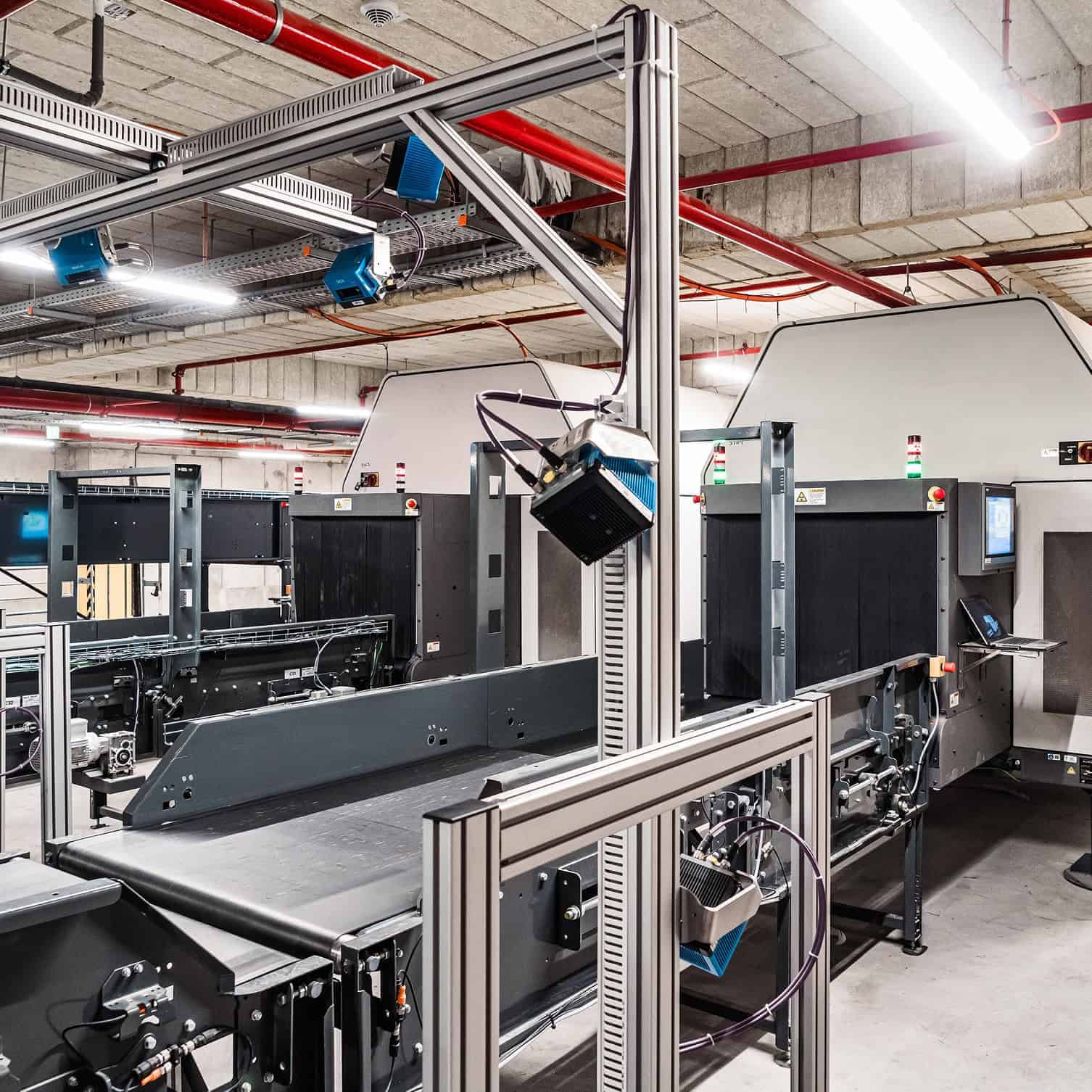
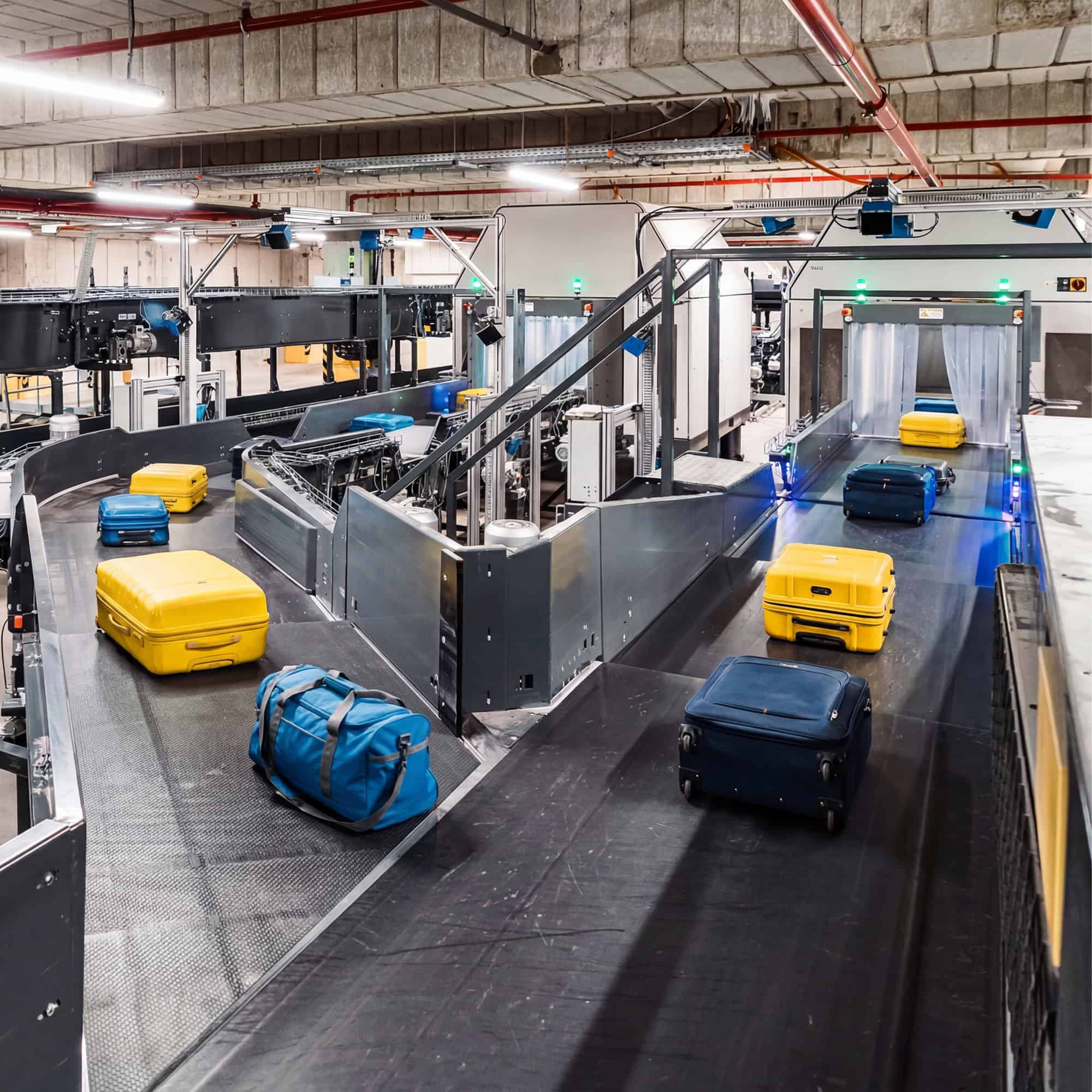
Security screening is often treated as a separate component of the baggage system. In reality, screening requirements can influence both the BHS configuration and the way the terminal itself is organized.
Equipment dimensions and weight, interfaces with conveyor belts, access requirements, operational clearances and screening configuration must all be accommodated within the BHS layout and correlated with terminal requirements. This becomes even more critical when new screening technology must be integrated into an existing system where available space and existing interfaces may already be constrained.
The impact does not stop at the screening equipment. Integrating new technology may necessitate modifications to belt geometry, a re-evaluation of structural provisions, the adjustment of electrical and mechanical interfaces and the adaptation of control and routing architecture.
For a new terminal, screening requirements should be considered while the spatial and technical concept is still in development, rather than treated as a package of equipment to be mounted into an already established BHS layout.
4. A System That Cannot Be Efficiently Maintained Was Not Designed for the Long Term
In a BHS intended for continuous, long-term operation, access for maintenance and intervention is a direct consequence of decisions made during the design phase.
During design, it is relatively simple to verify that equipment can be installed and that conveyors can operate within the available space. The more difficult question is what happens when a component needs to be accessed, isolated, adjusted or replaced while the terminal is operational.
Motors, drives, sensors, diverters and other components will eventually require intervention. If access to one of these implies dismantling surrounding equipment, moving unrelated installations or creating a significant operational restriction, this is not a maintenance issue that arose during operation, it is a design constraint established earlier.
Maintenance options must be considered alongside routing, equipment selection and space allocation. The system must ensure safe, practical access to components requiring intervention without generating avoidable disruptions to terminal operations.
This aspect is vital for systems designed for long-term performance. A BHS that can function for many years is only as resilient as the engineering solutions that allow it to be maintained, modified and restored when necessary.
5. Future Capacity Is Not Solved by Reserving Space, but by Protecting Interfaces
Preparing for the future expansion of a BHS is frequently reduced to simply allocating a reserved area. While space is a prerequisite, it does not guarantee the actual adaptability of the system over time.
Future capacity may depend on the availability of routing paths for conveyors, structural provisions, electrical capacity, control and communications infrastructure, screening interfaces and access for future installation work. If these interfaces are not considered when the original terminal is designed, the reserved area may remain physically available, but the infrastructure required to utilize it is no longer easily accessible.
Technological evolution is difficult to predict over a 10 or 20 year horizon. Baggage processing flows, screening technologies and automation levels will change and today’s project cannot anticipate tomorrow’s technical configuration in detail. What can be designed, however, is the infrastructure necessary for these changes to be integrated without major interventions in the terminal or existing systems. From this perspective, the scalability of a BHS does not mean just additional capacity or reserved space; it means preserving the technical flexibility required for the system’s evolution throughout its lifecycle.
The real stake is different: have the routes, interfaces, and infrastructure needed for future changes been protected from the beginning?
From Constraint to Design Opportunity
None of these constraints must turn into a compromise. If architecture, structure and BHS engineering are treated together from the early phases, constraints become starting points for better solutions: a routing problem can generate a different spatial configuration, screening can be integrated into the terminal concept from the start, maintainability can be treated as a long-term operational requirement, and future expansion can be prepared through protected interfaces long before they are needed.
There are also situations where a technical requirement can become part of the architectural concept, rather than just a constraint to be solved. BHS infrastructure is, for the most part, integrated into the terminal’s technical spaces and remains outside the visible passenger experience. However, when the architecture aims to expose and leverage airport operations, the BHS can become an integrated part of the space rather than just technical infrastructure that must be hidden. Such an approach influences how routing, protection, and access are conceived and shows what becomes possible when BHS engineering is involved early enough: the system can support the architectural vision, rather than having to adapt to already established decisions.
Every project requires its own solution, depending on the terminal concept, operational requirements and technical constraints. The important thing is that the technical requirement is analyzed early, while it can still be integrated into the design.
BHS engineering in the design phase is not just about capacity and baggage flows. It must account for how the system integrates into the building, the access required for maintenance and intervention during operation and the ability of the infrastructure to evolve with the airport.
When these interfaces are analyzed and resolved in time, BHS engineering can contribute to the design of the terminal, rather than merely adapting to decisions already fixed. In a project designed for the coming decades, flexibility is not left for later. It is built into the infrastructure from the beginning.
Design decisions made today determine how tomorrow’s infrastructure will perform. This is the standard we commit to in every terminal project we are part of.