

Airport BHS Installation in a Live Terminal: A Phased Approach to Upgrading Without Downtime
A BHS project delivered in an operational airport is not improvised. Every intervention must be planned around the operations that must be maintained, because the terminal continues to function throughout the works.
In an operational airport, any intervention on critical baggage processing systems represents a major challenge. The continuity of passenger flows, operational safety and compliance with processing times do not allow for extended shutdowns or conventional testing periods.
This situation is specific to terminal upgrade and expansion projects, where new infrastructure must be introduced while part of the existing system continues to operate. In such projects — whether involving terminal expansion, legacy system replacement, or the integration of new screening equipment — the challenge is the same: the new infrastructure must be introduced while part of the existing system continues to operate. The system is built around operations, not the other way around.
In an active terminal, work phasing becomes part of the project architecture. The sequence of interventions, the capacity available at each stage and the handover conditions between configurations must all be defined before works begin. This article describes how IESYS approaches this discipline.
1. WHY PHASED DELIVERY IS THE RULE, NOT THE EXCEPTION
An airport is a continuously operating infrastructure. In an operational terminal, the installation of a new BHS must be planned so that essential operations can continue throughout the works.
Phased delivery applies in any situation where BHS infrastructure must be expanded or replaced without shutting down the terminal: adding EDS lines for ECAC Standard 3 compliance, replacing a legacy system, expanding a pier with new check-in zones, or integrating a new sorting system alongside a partially operational BHS. The same challenge arises in airport expansion and upgrade projects that must build new infrastructure in parallel with existing operations.
The difference from a greenfield project is fundamental. In an active terminal, the airport’s operational constraints determine the windows in which the system can be modified. BHS planning must be built around these constraints.

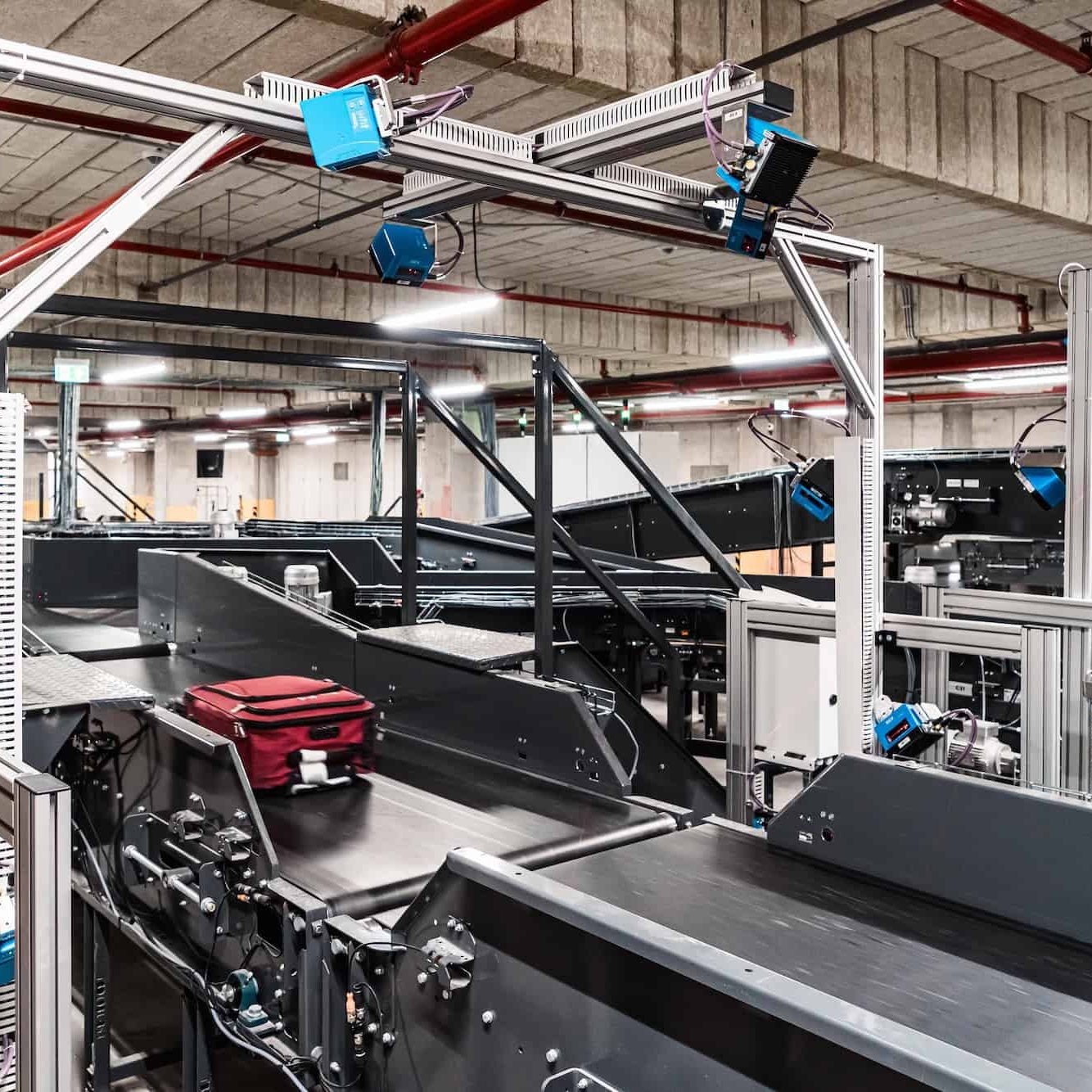
2. PLANNING THE INTERVENTION SEQUENCE
The core principle of segmentation is that, at every stage of the project, the minimum operational capacity required for the check-in and screening zones in service must be maintained. The integrator and the operator establish together, from the design phase, what this minimum capacity is and how baggage traffic is redistributed during each intervention.
The capacity available at each phase is determined starting from the airport’s operational profile: the flight schedule, traffic distribution across time intervals, BHS configuration and the capacity of each segment remaining in operation. This starts from the airport’s flight schedule, the distribution of traffic across time intervals and the identification of periods when capacity can be temporarily reduced without operational impact. A charter flight at 02:00 has an entirely different footprint on the BHS than a wide-body flight at 08:00.
Works requiring the shutdown of a system segment are scheduled within the lowest-impact windows. Intervention windows are negotiated and confirmed in advance. The physical configuration of the conveyors, the position of diverters and the route architecture determine which zones can be isolated without affecting the rest of the system. Temporary routing solutions are designed and logically verified before execution — not improvised at the moment of intervention. The documentation of this plan is part of IESYS’s design deliverables.
3. COORDINATION WITH GROUND HANDLING AND THE SECURITY AUTHORITY
In an active terminal, technical planning must be aligned with the operational plan for each intervention — not once at the start of the project, but before every physical intervention. Execution windows, available alternative lines and the conditions for returning equipment to service must be confirmed with the handling operator before each intervention. In unforeseen situations, the escalation procedure is activated immediately, not after the impact has already occurred.
Coordination with the airport security authority follows its own schedule. Depending on the nature of the modification and the applicable requirements, the integration or relocation of screening equipment and changes to secured flows may require approvals or validations from the competent authorities. Depending on the jurisdiction, this process can take days or weeks. The segmentation plan includes the schedule for obtaining these approvals for each phase. A phase that is technically complete but not approved by the security authority cannot enter service.
4. MANAGING THE OLD-NEW INTERFACE: PLC BRIDGING
In a phased project, the old system and the new system coexist for a period of time. The two must communicate and operate coherently, even if they are built on different control architectures. The technical solution to this challenge is PLC bridging — an interface layer that ensures the translation of commands and states between the legacy control system and the new SCADA (Supervisory Control and Data Acquisition) system.
Bridging design starts from the existing architecture: communication protocols, signals exchanged between systems, response times and how commands and states are managed when the two systems coexist. IESYS audits the existing control architecture before design begins and the bridging configuration results from this audit — it is not an improvised adaptation on site. Before going live, the bridging configuration must be verified, including from the perspective of command and state synchronization between the two systems; issues of this type are difficult to isolate after entry into service.
5. TESTING UNDER LIVE CONDITIONS
A system installed in an operational airport cannot be tested in fully isolated conditions. FAT (Factory Acceptance Testing) verifies control logic and individual components before delivery to site. Issues identified in the factory are incomparably easier to resolve than those discovered on site, with a limited intervention window.
SAT (Site Acceptance Testing) confirms that the integrated system functions under real conditions, with all airport interfaces active — AODB (Airport Operational Database), DCS (Departure Control System) and BRS (Baggage Reconciliation System). Prior to SAT, there is a parallel operation period during which segments of the new system enter service incrementally alongside still-active components of the old system. This window allows integration issues to be identified and corrected before the new system takes on the full operational load.
6. CUTOVER PROTOCOLS: WHEN AND HOW TO TRANSITION TO THE NEW SYSTEM
Cutover — the moment at which the new system’s functions are transferred to the new operational configuration — is one of the most sensitive stages of the project. The decision to proceed is based on pre-defined go/no-go criteria relating to test results, interface functionality, technical support availability,and compliance with applicable requirements.
These criteria typically cover the completion of acceptance tests without open critical issues, confirmation that interfaces with relevant airport systems are functioning, availability of the technical support team and fulfilment of applicable approval requirements. Any non-conformity affecting critical acceptance criteria must be assessed before transitioning to the new configuration.
Before cutover, degraded operating scenarios and the measures available in the event of unavailability of the new configuration are verified. Depending on the project architecture and transition strategy, these may include the use of alternative routes, the temporary retention of existing components, or a controlled capacity reduction. The specific sequence depends on the BHS geometry and configuration and on the operational capacity that must be maintained. IESYS designs these scenarios according to each airport’s configuration.
7. SUCCESS CRITERIA AND KPIs FOR PHASED DELIVERY
The success of a phased BHS project is not measured only at the completion of installation. Throughout execution, the indicators monitored include the operational capacity available at each point against the plan agreed with the operator, the number of disruptions generated by ongoing works and adherence to the phase schedule. A project that completes installation on time but generates repeated operational incidents along the way cannot be considered successful.
After cutover, system performance is tracked through standard KPIs: the misroute rate (bags incorrectly directed), the number of jams per operating hour, the uptime percentage and the false alarm rate at screening equipment. These indicators are monitored and reported to the operator during the stabilization period and form the basis of the as-built documentation of the delivered system.
CONCLUSION
Delivering a BHS in an operational airport tests more than the integrator’s technical competence. For this reason, the project must treat phasing, testing and the transition between configurations as part of the technical solution — not as separate execution stages.
The difference between a project that disrupts operations and one that goes unnoticed from the passenger’s perspective does not emerge during the execution phases. It emerges earlier — in the quality of the segmentation plan, in the clarity of the cutover criteria and in how well coordination with the operator and the security authority was prepared.
IESYS designs and integrates BHS systems in active terminals, with expertise in phased delivery, PLC bridging and coordination with airport operators and security authorities.