

The Critical 5: Five Reasons Baggage Identification Is Where BHS Performance Begins
- Episode 4 -
5 Reasons ATR Systems Are the Foundation of Every Baggage Handling Decision
A monthly insight series by IESYS
A baggage handling system doesn’t fail when identification fails. It continues.
Conveyors keep moving. Sorting logic keeps executing. From the outside, the system looks operational. The problem is in the data layer: without a correct tag read, the BHS continues processing but without certainty about what it is processing.
Most BHS performance metrics are measured in sorting throughput, capacity, and uptime. But system performance is determined earlier, at the point of baggage identification. Every downstream function depends on one condition: a correct tag read. When that condition is not met, the system does not stop. It produces exceptions.
Optical barcode scanning — the identification technology at the core of ATR systems — is the dominant standard at 73% of airports globally, according to IATA’s global baggage tracking survey. That dominance reflects a proven track record. It also defines the baseline against which operational performance is measured.
The five reasons below are not features from a product specification. They are the factors that, based on our experience in implementing airport baggage handling systems, determine whether identification infrastructure does its job or quietly compromises everything built on top of it.
#1 The system doesn’t stop. It continues without certainty
Before a baggage handling system can route a bag, reconcile it to a passenger, validate it through a security workflow, or track it across the terminal, it needs to answer one question: what bag is this?
That question is answered once — at the point of tag reading. When it isn’t answered correctly, the BHS control system cannot determine flight association, destination routing, sorting priority, boarding authorisation or reconciliation status.
An unidentified bag immediately becomes a system exception. Manually encoded at a staffed workstation, recirculated through a no-read loop or held for intervention. At scale, even a modest increase in no-read rates creates cascading delays across the entire conveyor network — not because the system has stopped, but because it is processing uncertainty at full speed.
This is why ATR systems should not be treated as peripheral scanning hardware. They are the identity gateway of the baggage lifecycle, and their reliability determines the integrity of every process that follows.

#2 Read accuracy is measured in exceptions, not percentages
ATR read accuracy is typically presented as a percentage in a product datasheet. What that number means in operational terms is rarely discussed with the same precision.
The difference between 98% and 99.5% read accuracy does not sound significant. In a high-volume terminal processing thousands of bags per hour, it translates directly into the number of bags that cannot be automatically routed — bags that require manual encoding, recirculation or exception handling. Even small gaps in read performance generate measurable pressure on staffing, conveyor throughput, and turnaround efficiency.
Improving read accuracy from 98% to 99.5% produces a measurable reduction in manual encoding workload, recirculation loops and sorting delays. Across a busy hub, that translates into significant gains in operational predictability and staff deployment. Reliable ATR performance enables stable throughput, reduced buffer accumulation and improved aircraft turnaround.
Read accuracy is typically expressed as a percentage. But percentages describe performance in controlled conditions. Exceptions describe impact in real ones — manual encoding, recirculation, turnaround pressure. Every shift. Every day.
#3 Real-world conditions are what the system actually runs on
Every ATR system is tested and specified under controlled conditions. Operational airports are not controlled environments.
Baggage tags are printed at different quality levels, applied in different positions, exposed to physical handling between check-in and the first scanning point, and arrive at ATR positions folded, damaged, or partially obscured. Bags arrive at varying orientations, at varying speeds, with variable spacing between them. These are not edge cases. They are the default conditions of a functioning terminal.
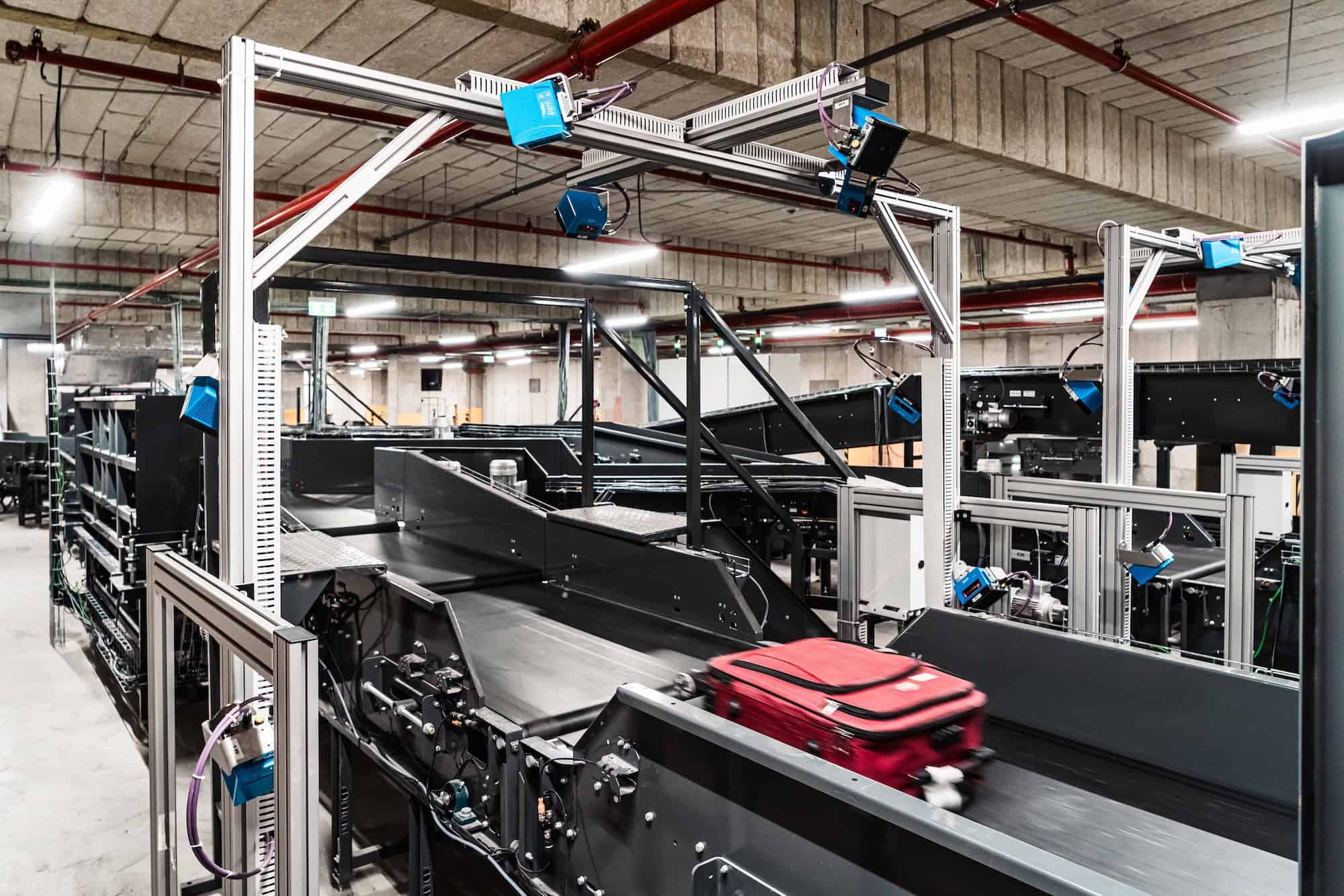
Reliable performance in these conditions is not a default. It is the result of deliberate engineering choices at each reading point: how cameras are configured to handle tag orientation variability and how processing logic is matched to the actual dynamics of the conveyor environment.
The gap between specified performance and delivered performance is almost always found here: in the tolerance of the system for conditions that look nothing like the test environment.
#4 Placement is where read failures are designed in or designed out
Where an automatic tag reader is positioned and how it is configured determines how well it reads. This seems straightforward. In practice, it is one of the most consequential decisions in BHS implementation and one of the most frequently underestimated.
Critical parameters include conveyor speed at the reading point, camera angle and coverage geometry, lighting conditions and their interaction with tag surface finishes, baggage spacing, and the mechanical stability of the installation structure. None of these can be resolved after installation. They must be designed before it.
Errors introduced at the design and installation stage manifest as persistent read failures that are difficult and costly to resolve once a system is operational. Improper positioning cannot be compensated through software adjustment. This is not a vendor problem. It is an integration problem and it falls to the integrator to resolve it before the system goes live, not after.
#5 Integration is what turns identification into operational value
An automatic tag reader, considered in isolation, identifies bags and transmits data. That is its function and its boundary. The value of that function is only realised when the data it produces is correctly connected to the systems that act on it.
Through integration with Baggage Reconciliation Systems, ATR identification data becomes the basis for passenger-bag matching, boarding status validation and loading authorisation. This positive bag-passenger reconciliation process is a compliance requirement under IATA Resolution 753 and ICAO guidelines, a foundational element of security operations at every commercial airport in regulated airspace.
Through integration with BHS control logic, it enables automated routing, exception handling workflows, security-related decision triggers, and event logging for audit and traceability purposes. These connections do not happen automatically. They require deliberate integration architecture and a clear understanding of how data flows between the ATR (Automatic Tag Reader), the BRS (Baggage Reconciliation System), the BHS (Baggage Handling System) control environment, and associated airport platforms.
Once operational, ATR systems generate a continuous, timestamped record of every identification event across the network — capturing location data, routing decisions and exception events. This audit trail supports operational monitoring, early detection of degrading read accuracy, security investigations and regulatory compliance. As airports move towards more integrated operational models, the fidelity of ATR data becomes an infrastructure asset that extends across the full life of the installation.
It is also worth being precise about one boundary: ATR systems identify and transmit. They do not apply security intelligence or make autonomous decisions. Those functions belong to higher-level systems operating on predefined rules. What the ATR contributes is the accuracy and reliability of the identification data that those systems depend on. When that data is correct and arrives in time, the downstream logic can function as designed. When it is not, no amount of sophistication in the control layer can recover it.
Conclusion
A baggage handling system is not as reliable as its most complex component. It is as reliable as its first one.
BHS performance metrics measured in sorting throughput, capacity and uptime tell part of the story. But system performance is determined earlier, at the point of identification. When identification is consistent and correctly integrated, the entire downstream architecture operates closer to design capacity. When it is not, the system continues running — processing uncertainty at full speed.
For us, implementing ATR systems as part of integrated baggage handling environments means making the right engineering decisions before installation: in the placement design, in the integration architecture, in the calibration of real operational conditions against system capabilities. Not because these details are interesting in themselves, but because they determine whether the system performs as designed — in the first week and three years later.
About IESYS
IESYS designs and implements baggage handling systems as part of integrated airport infrastructure. Our experience covers the full implementation chain — from system design and automatic tag reader configuration to integration with BRS environments, BHS control platforms, and associated airport operational systems.
If you work in airport infrastructure and want to understand what a reliable ATR implementation looks like in practice, our team is available.